Reading Dog Body Language: Ears
While dogs cannot speak to us in the same words we use, they are still communicating with us in a way that we can understand with a little bit of practice. It is important to be able to interpret what they are saying correctly to mitigate stress and reduce the chances of bites or broken trust between you and your dog. I have often seen that people think they know what a tail wag means, but it can in fact be a lot more nuanced than just a tail wag. In this series, I will describe exactly what to look for in dog body language to understand what they are silently trying to communicate to us.
The first thing I want to explain are two terms: distance increasing and distance decreasing signals. Distance increasing signals are behaviors that dogs do to show that they want to us increase the distance between them and the other person or animal—in other words: “back off!” Distance decreasing signals are behaviors that dog do to show that it is okay to decrease the distance between them and the other person or animal. In other words: “I’m okay with you coming a little closer.” I will explain what each of these different signals look like in each major area of the dog’s body. Here we will focus on the ears.

Distance Increasing Signals (left) are how your dog tells you to back up. Distance Decreasing Signals (right) are how your dog tells you that you are welcome to come a little closer.
Dog ears have 12 more muscles than human ears, allowing them to rotate, tilt, and raise their ears in ways that we simply cannot. Not only does this allow them to pinpoint sounds better, they are also able express their emotional state using their ears. For example, ears down and pinned back express fear. You will often notice other signs throughout the rest of the body like crouching, tension in the mouth, whale eye, and a tucked tail. These are all signs that your dog is scared and you should stop what you are doing.

Ears down and pinned back indicate fear and that you should stop what you are doing so the situation doesn’t escalate.
A more aggressive stance is when the ears are perked but tightly folded. Their ears take this shape because they are more alert and tense. You will often see wrinkles on the nose, front teeth exposed, hard eyes, a stiff and forward-leaning body, and a high and stiff tail. If you see this stance, back off immediately. Your dog likely feels that their only option left is to bite.
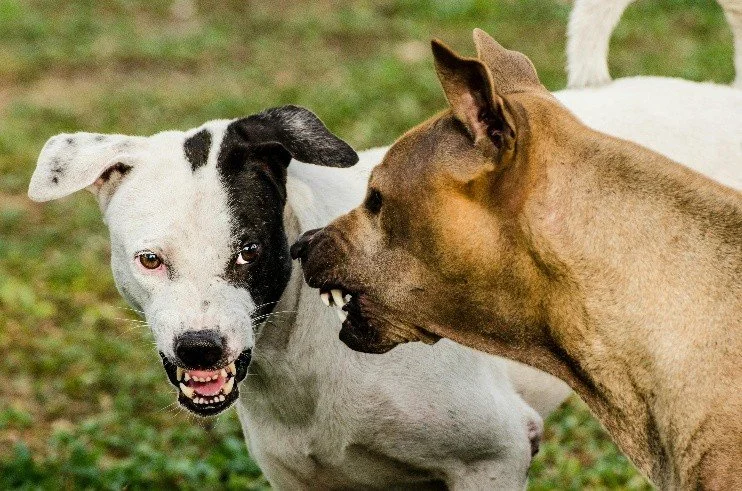
Ears high and tightly folded indicate a more aggressive emotional state. Immediately back off to avoid a bite.
Dog ears are tricky because distance increasing and distance decreasing signals can look similar. It is important to pay attention to other body cues in conjunction with their ears to get the full picture. For example, their ears might be held up and forward, but they won’t be as tightly folded. You will notice the rest of the body is not tensed (nose is not wrinkled, mouth is closed or held loosely open, eyes are soft, the tail and body are neutral or loose). This ear position means they are alert to what’s happening in front of them but they are not perceiving it as a threat.
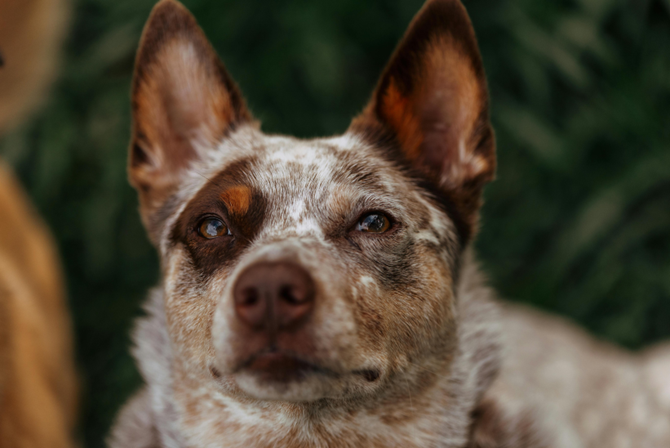
Ears that are up and forward can also just indicate that the dog is alert to what is in front of them. Pay attention to the rest of the body to notice a more relaxed emotional state.
Their ears may also fall to the sides, but they will be relaxed rather than pinned back. Again, their eyes will be soft, and their mouth, body, and tail will be loose rather than tensed. This is another sign that your dog is comfortable with what you are doing. When you continue to close the gap with your dog, be sure to pay attention to how their body language changes. If they start showing distance increasing signals, stop what you are doing. Just because they were comfortable with what you were doing before, this does not mean they are comfortable with you getting closer or doing something different.
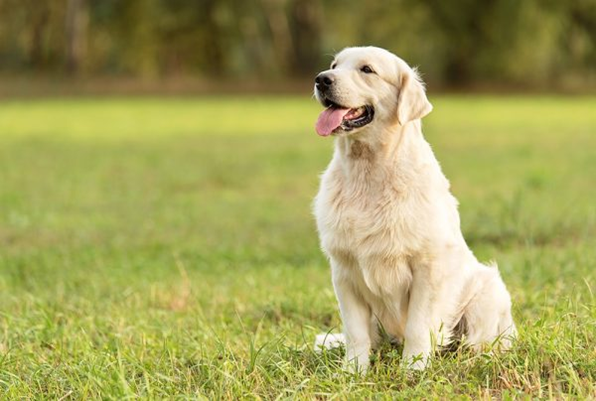
Ears that fall to the side, but are relaxed and are accompanied by other relaxed signals indicate a calm dog.
Just like humans use body language to communicate, so do dogs. While some of what they do might mean different things than what they mean in people, we can learn and use their cues to ensure that we are interpreting their signals correctly. Differentiating between tense and pinned ears, and relaxed or simply alert ears is key for understanding how our dogs are feeling. We can continue to build trust in our animals and strengthen our human-animal bonds by listening to what they are saying and respecting their boundaries.

These tips aren’t just for you—make sure that, if you have kids or any other people that interact with your dog, you help them understand these cues, too. If you notice your dog is uncomfortable with what someone is doing, speak up for your dog or remove them from the situation. You understand your dog’s body language while others may not. You are their voice in situations like that.
To learn more about dog body language, continue to follow this series. For more individualized help with dog training and behavioral management, please view my services here.