Reading Dog Body Language: Snout
While dogs cannot speak to us in the same words we use, they are still communicating with us in a way that we can understand with a little bit of practice. It is important to be able to interpret what they are saying correctly to mitigate stress and reduce the chances of bites or broken trust between you and your dog. I have often seen that people think they know what a tail wag means, but it can in fact be a lot more nuanced than just a tail wag. In this series, I will describe exactly what to look for in dog body language to understand what they are silently trying to communicate to us.
The first thing I want to explain are two terms: distance increasing and distance decreasing signals. Distance increasing signals are behaviors that dogs do to show that they want to us increase the distance between them and the other person or animal—in other words: “back off!” Distance decreasing signals are behaviors that dog do to show that it is okay to decrease the distance between them and the other person or animal. In other words: “I’m okay with you coming a little closer.” I will explain what each of these different signals look like in each major area of the dog’s body. Here we will focus on the snout.

Distance Increasing Signals (left) are how your dog tells you to back up. Distance Decreasing Signals (right) are how your dog tells you that you are welcome to come a little closer.
A dog’s snout is often where our facial cues stop being similar to them. We see people post adorable or goofy photos and videos of their dogs “smiling,” however sometimes these aren’t actually happy dogs. A closed mouth, long-lipped smile is an appeasement behavior in dogs that are afraid. If you see this “smile,” especially combined with whale eye or an averted gaze and ears back, it’s time to change what you are doing so your dog feels more comfortable.
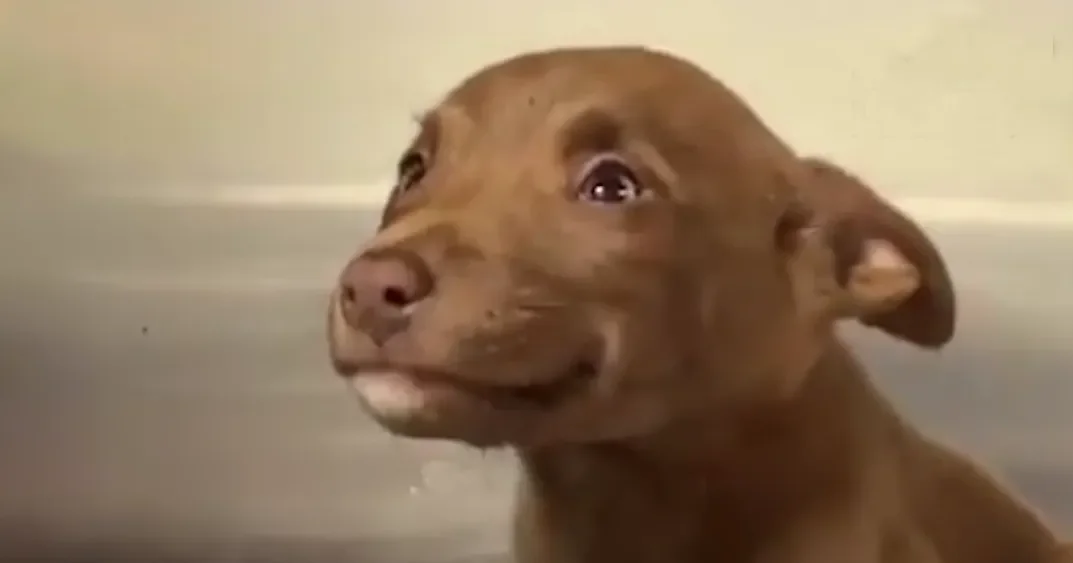
The caption for this photo was that the puppy was grateful to be rescued from a shelter and that’s why she was smiling. While I’m sure the puppy did in fact appreciate being taken into a loving home, this “smile” was not of gratitude. This puppy was nervous and was showing an appeasement behavior called a long-lipped smile.
Any sort of tension in the mouth is not a good sign. If you see puffing at the front of the snout, occasionally accompanied by a low growl, give your dog space immediately. This is them warning you that they do not feel comfortable with what you are doing and they are starting to lose options for telling you that. This is easiest to see in a longer snouted dogs, but pay attention to the tension in the face of a flat-faced dog as well. This is often accompanied by other signs, such as hard eyes as well.
The final escalation is when you see wrinkling on the top of the snout and your dog’s front teeth are bared. This is the point where they have had enough and any further provocation will more than likely lead to a bite. You’ll often see tightly folded ears and hard eyes in this scenario as well.
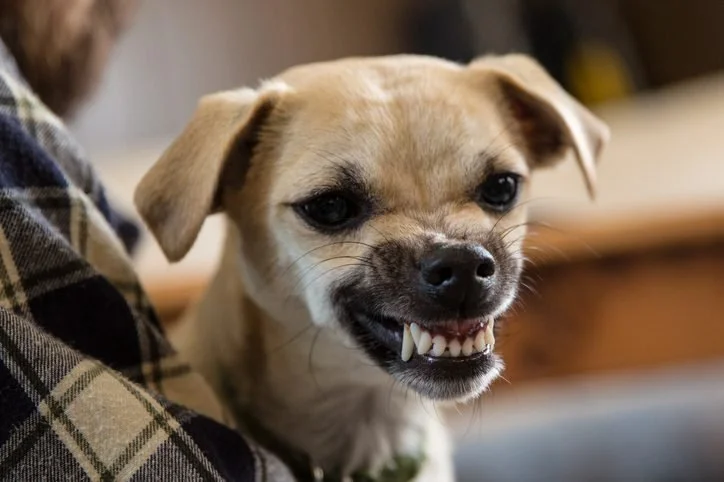
This dog is baring its front teeth with wrinkling on the top of the snout, which is a major distance-increasing signal. Give your dog some space or remove the threat immediately to avoid bites.
Other behavioral signs of stress that you’ll see in the snout area is yawning, panting, and licking lips. While they do this spontaneously on occasion, if the yawning or lip licking is excessive or out of place, your dog is likely stressed. These are usually very early signs of stress, but they are still important to take note of in conjunction with other behavioral cues.
A comfortable dog has a loose mouth. It is either closed with no tension, or it hangs loosely open. This should be accompanied with soft eyes, and relaxed ears, body, and tail. If you choose to continue to close the gap with your dog, be sure to pay attention to how their body language changes. If they start showing distance increasing signals, stop what you are doing. Just because they were comfortable with what you were doing before, this does not mean they are comfortable with you getting closer or putting more pressure on them.
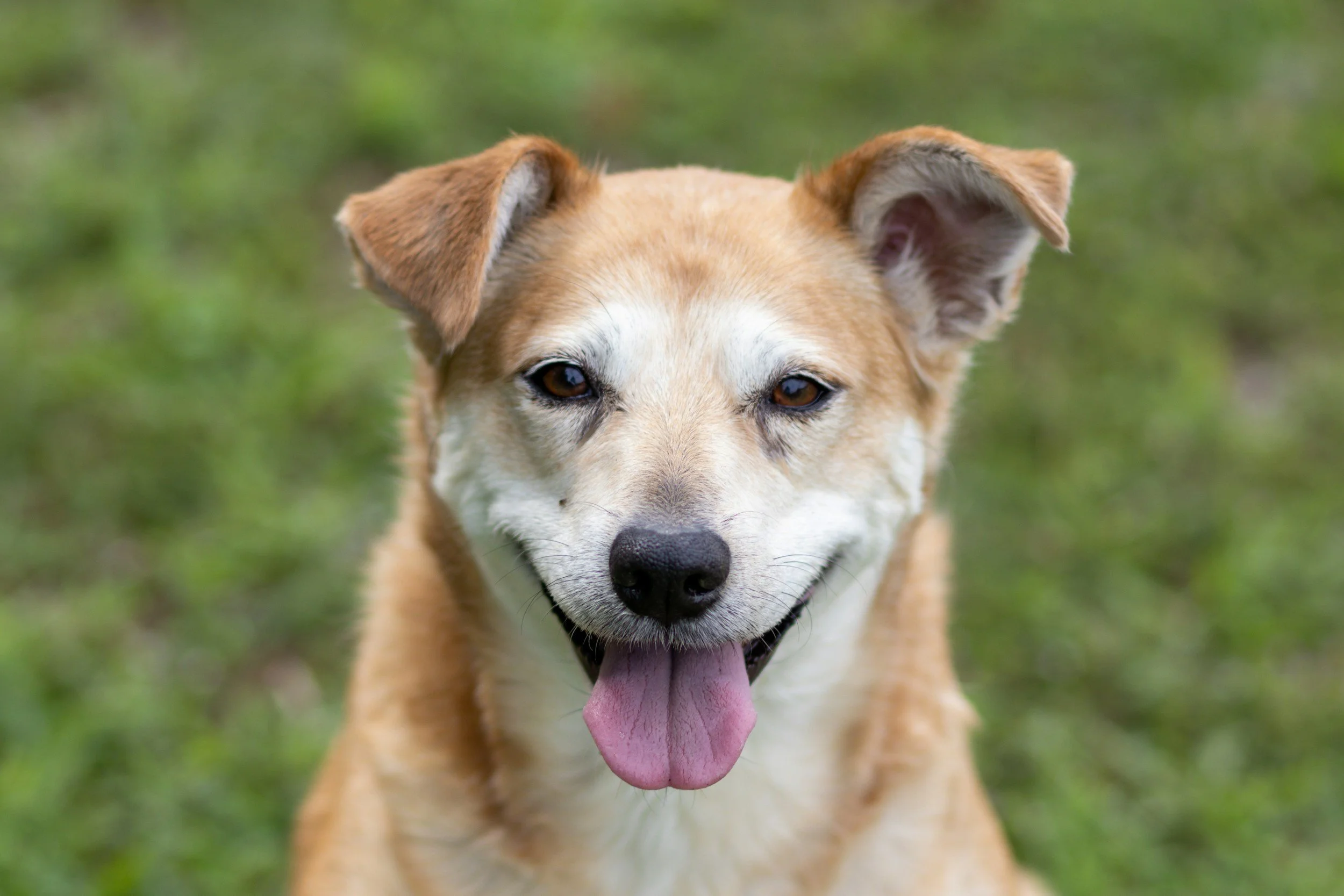
This dog’s mouth is held loosely open. Its eyes are soft and ears are forward but relaxed. This indicates a calm dog and is a distance-decreasing signal.
Just like humans use body language to communicate, so do dogs. While some of what they do might mean different things than what they mean in people, we can learn and use their cues to ensure that we are interpreting their signals correctly. Understanding that a dog’s “smile” doesn’t mean the same thing that it means in humans can help prevent bites and broken trust. We can continue to build trust in our animals and strengthen our human-animal bonds by listening to what they are saying and respecting their boundaries.
These tips aren’t just for you—make sure that, if you have kids or any other people that interact with your dog, you help them understand these cues, too. If you notice your dog is uncomfortable with what someone is doing, speak up for your dog or remove them from the situation. You understand your dog’s body language while others may not. You are their voice in situations like that.
To learn more about dog body language, continue to follow this series. For more individualized help with dog training and behavioral management, please view my services here.